
Eta Carinae Nebula

The Eta Carinae Nebula (NGC 3372) is one of the largest and most spectacular star-forming regions in the Milky Way. Located about 7,500 light-years away in the southern constellation Carina, it spans an enormous 260 light-years across, making it far larger than the famous Orion Nebula. From dark southern skies, it appears as a bright, misty patch in the Milky Way, glowing with energetic light from newborn stars and massive stellar clusters. This region provides astronomers with a close-up look at some of the most intense and dynamic processes in the galaxy, where stars are born, shaped, and sometimes destroyed.
| Date | DD/MM/YYYY |
| Location | Coimbatore, India |
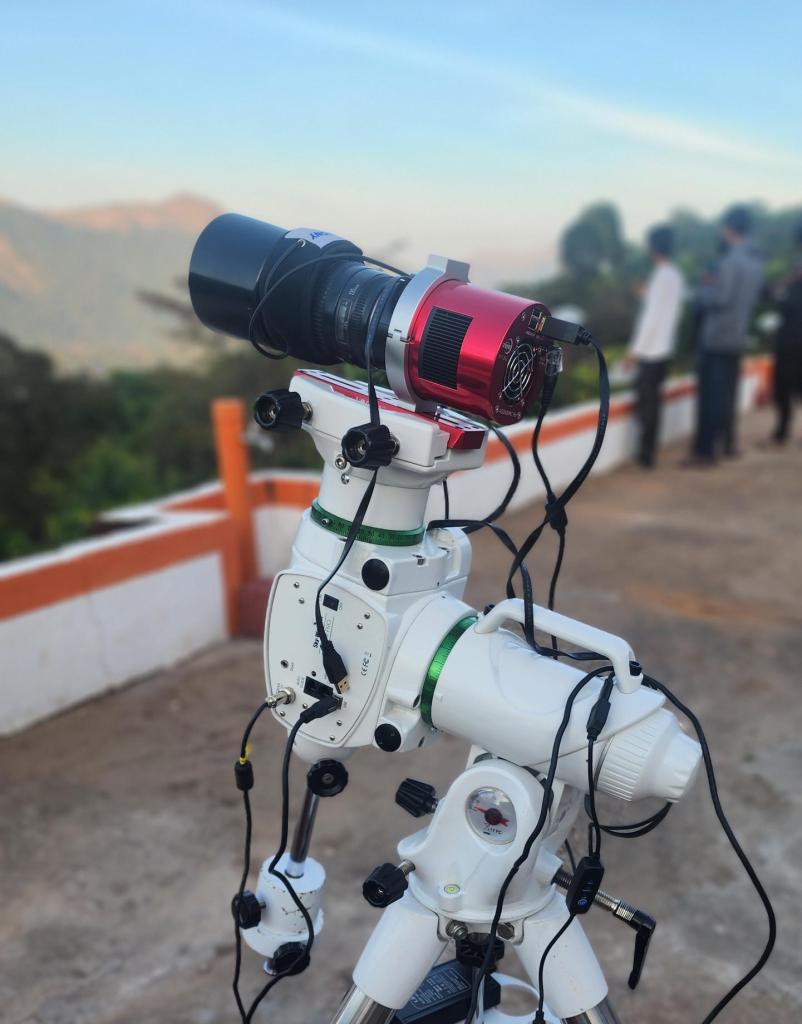
| Camera | ASI2400MC Pro |
| Lens | Canon 135mm f/2 |
| Filter | Quadband Filter |
| Mount | EQ6R Pro |
| Lights | 40 × 90 seconds |
| Darks | 10 × 90 seconds |
| Total Integration Time | 60 minutes |
| Stacked | Deep Sky Stacker |
| Post Processing | Adobe Photoshop & Lightroom |
At the heart of this vast nebula lies Eta Carinae, one of the most massive, luminous, and unstable star systems known. With a combined mass of around 100 Suns and a brilliance nearly one million times brighter than our Sun, it burns through its fuel at an extraordinary rate. Eta Carinae is famous for its violent history especially the Great Eruption of the 1840s, when it suddenly brightened to become the second brightest star in the night sky for nearly two decades. This outburst blasted off huge amounts of material, forming the iconic Homunculus Nebula, a glowing, double-lobed shell that continues to expand outward. Modern telescopes have even detected light echoes of this eruption reflecting from distant clouds, allowing scientists to study the event long after it happened.
Today, Eta Carinae remains a highly active and unpredictable system, offering a rare glimpse into the late-life stages of the universe’s most massive stars. Astronomers believe it is nearing the end of its life and will eventually explode as a supernova, although the timing is uncertain it could be in a few years, or it could take hundreds of thousands more. Its powerful stellar winds, intense radiation, and dramatic changes in brightness make Eta Carinae a natural laboratory for understanding extreme astrophysics. Studying this system helps scientists learn how giant stars evolve, how they enrich their surroundings with heavy elements, and how they ultimately shape the structure of galaxies.
best months to photograph from india
The best months to photograph the Eta Carinae Nebula from India are during the late winter and early summer sky window, typically from February to April. During this period, the constellation Carina rises higher above the southern horizon, giving clearer views and longer imaging time. February and March offer the most stable and transparent night skies, while April still provides good visibility shortly after dusk. Since Eta Carinae sits deep in the southern sky, these months give the optimal combination of altitude, clarity, and darkness for capturing its bright nebula and surrounding structures