
Rosette & Chirstmas Tree Nebula

The Rosette Nebula and the Christmas Tree Nebula are two beautiful star-forming regions found in the winter sky, each showcasing the creativity of nature in shaping cosmic clouds. The Rosette Nebula lies about 5,200 light-years away in the constellation Monoceros, forming a large, circular structure that resembles a blooming cosmic rose. The Christmas Tree Nebula, located roughly 2,400 light-years away in Monoceros as well, gets its festive name from the triangular arrangement of stars and glowing gas that looks like a decorated tree. Although both nebulae are made of hydrogen gas and dust, their shapes are sculpted by the young stars forming inside them.
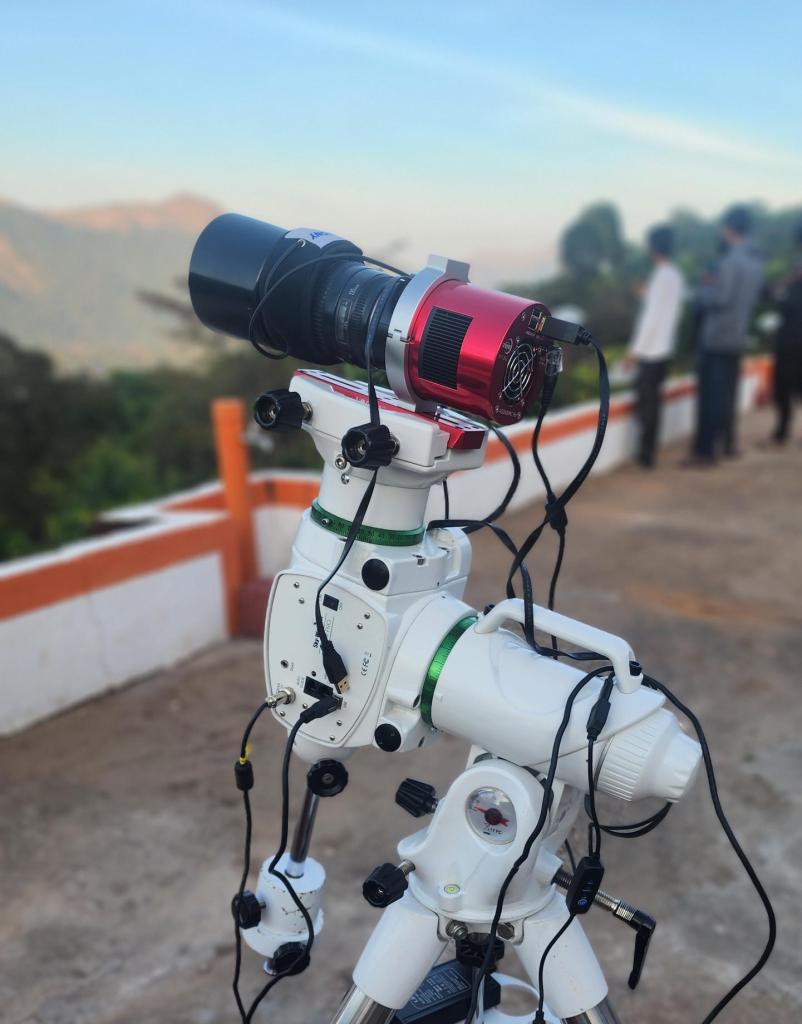
| Camera | ZWO ASI2400 MC Pro |
| Lens | Canon 135mm f/2 |
| Filter | Quadband Filter |
| Mount | EQ6R Pro |
| Lights | 32 × 120 seconds |
| Darks | 10 × 120 seconds |
| Total Integration Time | 1 hour 4 minutes |
| Stacked | Deep Sky Stacker |
| Post Processing | Adobe Photoshop & Lightroom |
The Rosette Nebula is an enormous emission nebula, spanning over 100 light-years across, with a bright central cavity carved out by the star cluster NGC 2244. The radiation and stellar winds from these hot, newborn stars heat and ionize the surrounding gas, creating the glowing red and pink colors seen in the photograph. The Christmas Tree Nebula is part of the larger NGC 2264 region, which also includes the Cone Nebula. Its blue and white glow comes from the intense light of young, hot stars reflecting off nearby dust, while the surrounding hydrogen clouds shine in soft reds. In both nebulae, dense pockets of gas collapse under gravity, giving rise to new stars that continue to shape the clouds around them.
Astronomers study these nebulae using visible-light telescopes to capture their striking colors, and infrared instruments to see hidden young stars inside the dusty regions. Observations reveal shock fronts, young stellar clusters, and dark filaments all signs of active star formation. Together, the Rosette Nebula and Christmas Tree Nebula help scientists understand how star clusters form, how massive stars influence their surroundings, and how giant clouds of gas evolve.
best months to photograph from india
Both nebulae are popular targets for winter astrophotography, where Monoceros rises well in the late-night sky. The ideal viewing and imaging season is December through March, with January and February offering the best altitude and darkest skies. Wide-field lenses capture the Rosette’s full circular structure, while telescopes reveal the detailed texture of the Christmas Tree Nebula and the Cone Nebula below it.