
Total Lunar Eclipse
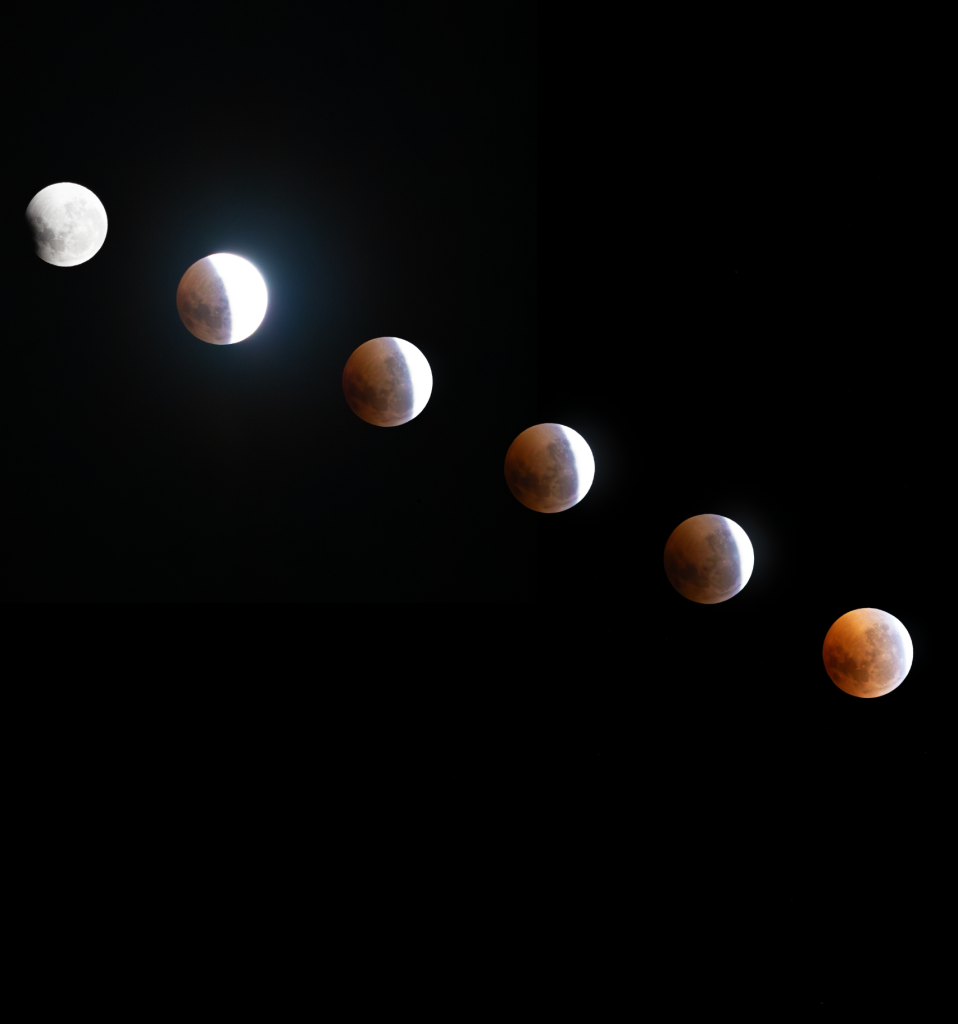
A total lunar eclipse happens when the Earth’s shadow falls fully on the Moon that is, when Earth moves directly between the Sun and the Moon, aligning all three bodies. During this alignment, no direct sunlight reaches the Moon, so it doesn’t shine in its usual bright white glow. Instead, as the Moon passes through Earth’s umbra (the darkest part of Earth’s shadow), it often takes on a deep red or copper hue a phenomenon known as a “Blood Moon.” This happens because when sunlight passes through Earth’s atmosphere, it filters off the blue light while red and orange light bends through the Earth’s atmosphere and illuminates the Moon’s surface.
- Penumbral phase: A faint shading appears as the Moon enters the Earth’s outer shadow (Penumbral region).
- Partial phase: A noticeable dark bite begins to move across the Moon.
- Totality: The Moon is fully inside Earth’s shadow (Umbral region) and glows red and stays that way until it starts to exit the shadow.
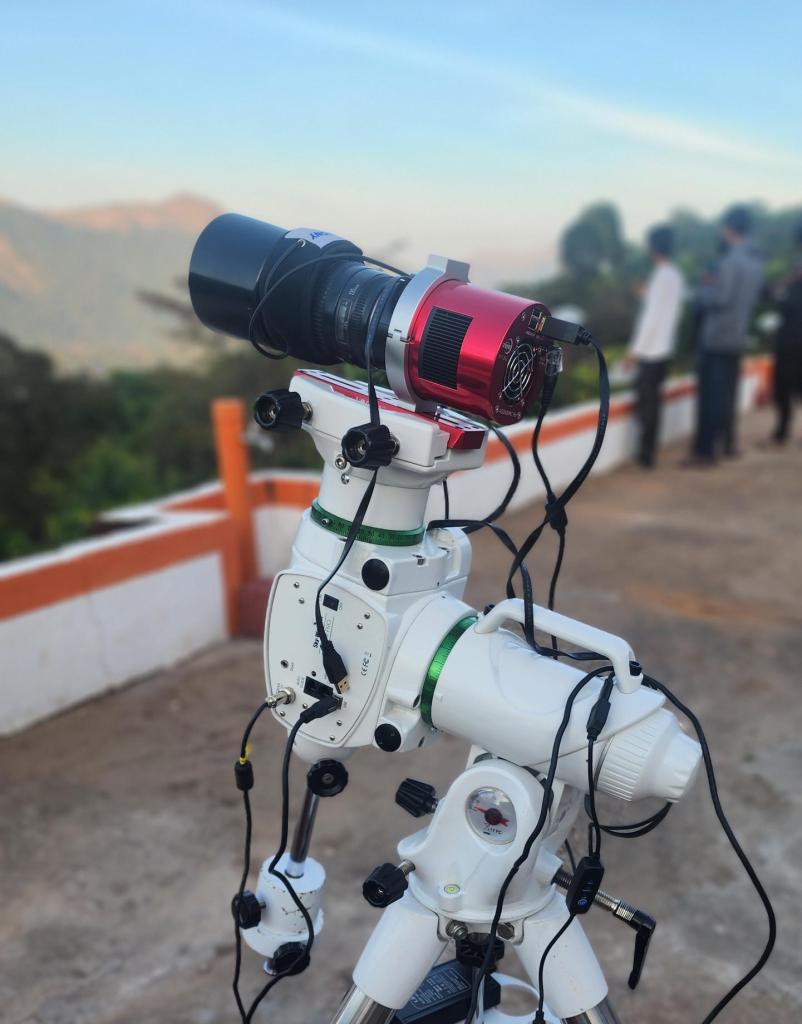
| Camera | Canon 5D |
| Lens | 150mm f/4 |
| Filter | None |
| Mount | Non-tracking Mount & Tripod |
| Lights | Different exposure for each moon frame |
| Darks | None |
| Total Integration Time | Sequence image spanning over several minutes |
| Stacked | No |
| Post Processing | Photoshop & Lightroom |
As totality ends and the partial and penumbral phases reverse, the Moon gradually returns to its normal brightness. Because of this gradual progression, a lunar eclipse is easy to observe with the naked eye, and many people enjoy watching the eerie red glow without needing any special equipment.
Total lunar eclipses are among the most accessible and dramatic celestial events. Unlike solar eclipses, there’s no danger to your eyes, you can safely watch the entire event. For skywatchers, it offers a rare chance to see our companion world bathed in strange, soft light, in a display that connects Earth, its atmosphere, and space in a single moment.
best months to photograph from india
Here are the dates of the next three Total Lunar Eclipses that are visible from India:
- 31 December 2028 (Total Lunar Eclipse – scheduled for New Year’s Eve, with visibility over Asia and parts of the Indian region (depending on time and moonrise).
- 20 December 2029 (Total Lunar Eclipse – listed among upcoming eclipses in the Indian subcontinent’s eclipse calendar.)
- 25 April 2032 (Total Lunar Eclipse – The entire shadow path crosses much of Asia, Australia, Africa, and parts of Europe, making it potentially visible from many locations in the eastern hemisphere.)