
Jellyfish & Monkey Head Nebula
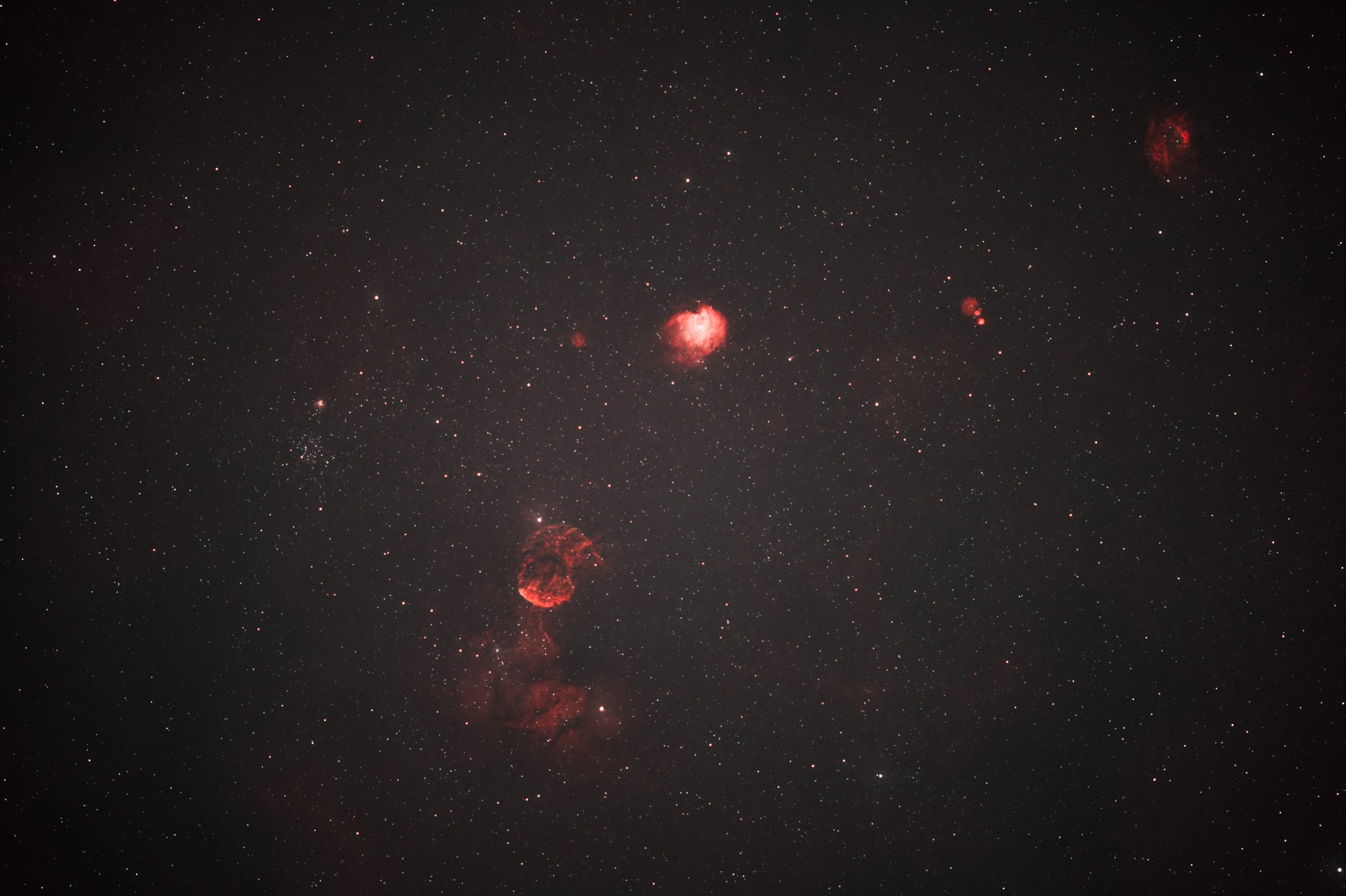
The Jellyfish Nebula (IC 443) and the Monkey Head Nebula (NGC 2174) are two remarkable nebulae that reveal very different stages in the life cycle of stars. The Jellyfish Nebula lies about 5,000 light-years away in the constellation Gemini, formed from the explosive death of a massive star. In contrast, the Monkey Head Nebula sits around 6,400 light-years away in the constellation Orion, glowing brightly as a region where new stars are being born. Though they differ in origin one shaped by destruction and the other by creation both nebulae help astronomers understand how stars influence the universe.
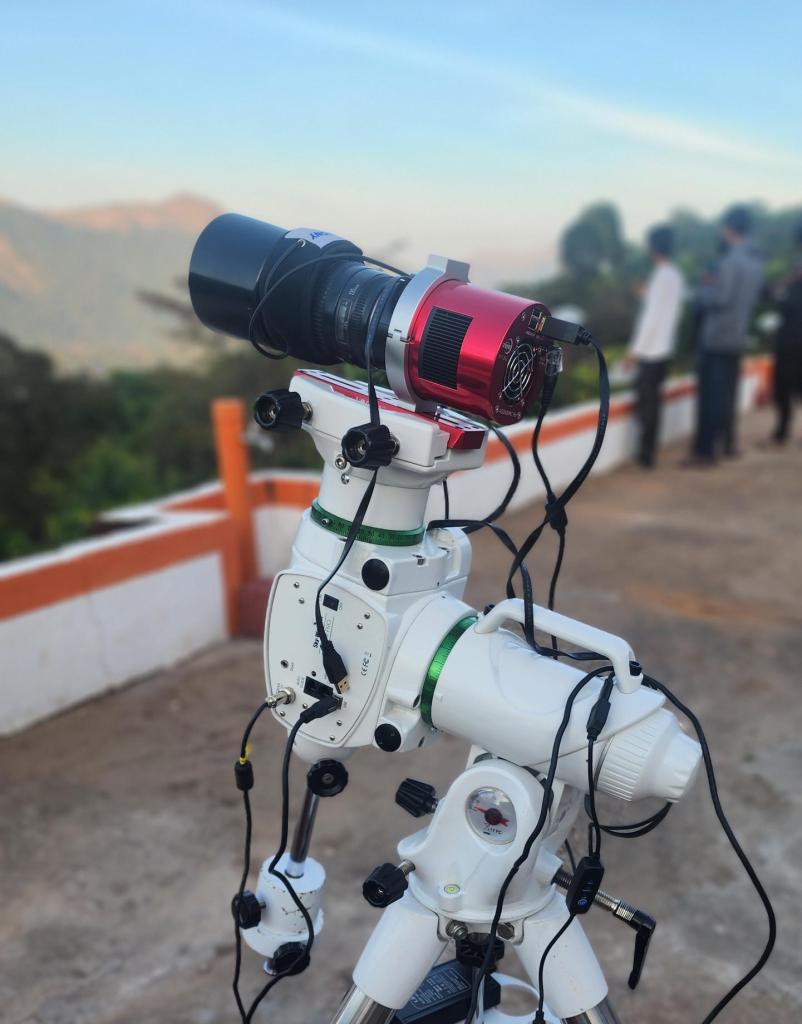
| Camera | ZWO ASI2400 MC Pro |
| Lens | Canon 135mm f/2 |
| Filter | Quadband Filter |
| Mount | EQ6R Pro |
| Lights | 24 × 150 seconds |
| Darks | 10 × 150 seconds |
| Total Integration Time | 1 hour |
| Stacked | Deep Sky Stacker |
| Post Processing | Adobe Photoshop & Lightroom |
The Jellyfish Nebula is a supernova remnant, roughly 70 light-years across, made of long, trailing filaments that resemble a jellyfish. NASA’s Chandra X-ray Observatory has shown that the explosion may have created a rapidly spinning neutron star (pulsar) near the nebula’s southern edge. The age of IC 443 remains uncertain: some studies estimate it to be around 30,000 years old, while others suggest it could be as young as 3,000 years. On the other hand, the Monkey Head Nebula is a bright star-forming region, known for its rounded shape that looks like a monkey’s head. Its red glow comes from strongly ionized hydrogen gas, and it is powered by the young star cluster NGC 2175, whose intense ultraviolet radiation sculpts the gas into ridges, bubbles, and cavities.
Astronomers study these nebulae using visible light, X-ray, and infrared observations. X-ray telescopes reveal the shock waves and energetic particles left behind in the Jellyfish Nebula, while infrared instruments—including those on the James Webb Space Telescope can peer into the Monkey Head Nebula’s dusty clouds to uncover new stars forming inside. Together, these two nebulae highlight both ends of the stellar cycle: the violent end of a massive star in the Jellyfish, and the birth of new stars in the Monkey Head. This makes them powerful examples of how the universe continually reuses and reshapes cosmic material over time.
best months to photograph from india
#The best time to photograph both the Jellyfish Nebula (IC 443) and the Monkey Head Nebula (NGC 2174) from India is during the winter months, when their constellations, Gemini for the Jellyfish and Orion for the Monkey Head, are high in the night sky. From December to March, these regions reach excellent altitude and remain visible for long imaging sessions. January and February offer the most favorable skies, with clearer conditions and both nebulae positioned well toward the south and southeast around late evening to midnight. This period provides the ideal balance of visibility, altitude, and atmospheric stability for capturing detailed images of these two bright and popular nebulae. #